Technology / Communications & Integrations
Communications & Integrations
TrackLab supports multiple field communication protocols and a deployment-specific upstream connectivity model, allowing each site to choose the best combination for its terrain, infrastructure, and operational requirements.
Protocol flexibility is a core design principle. Sites can use LoRa for wireless, RS485 or CAN-2.0 for wired reliability, fibre for high-bandwidth TCP/IP connections, and mix protocols across different sections of the same farm.
Protocol Overview
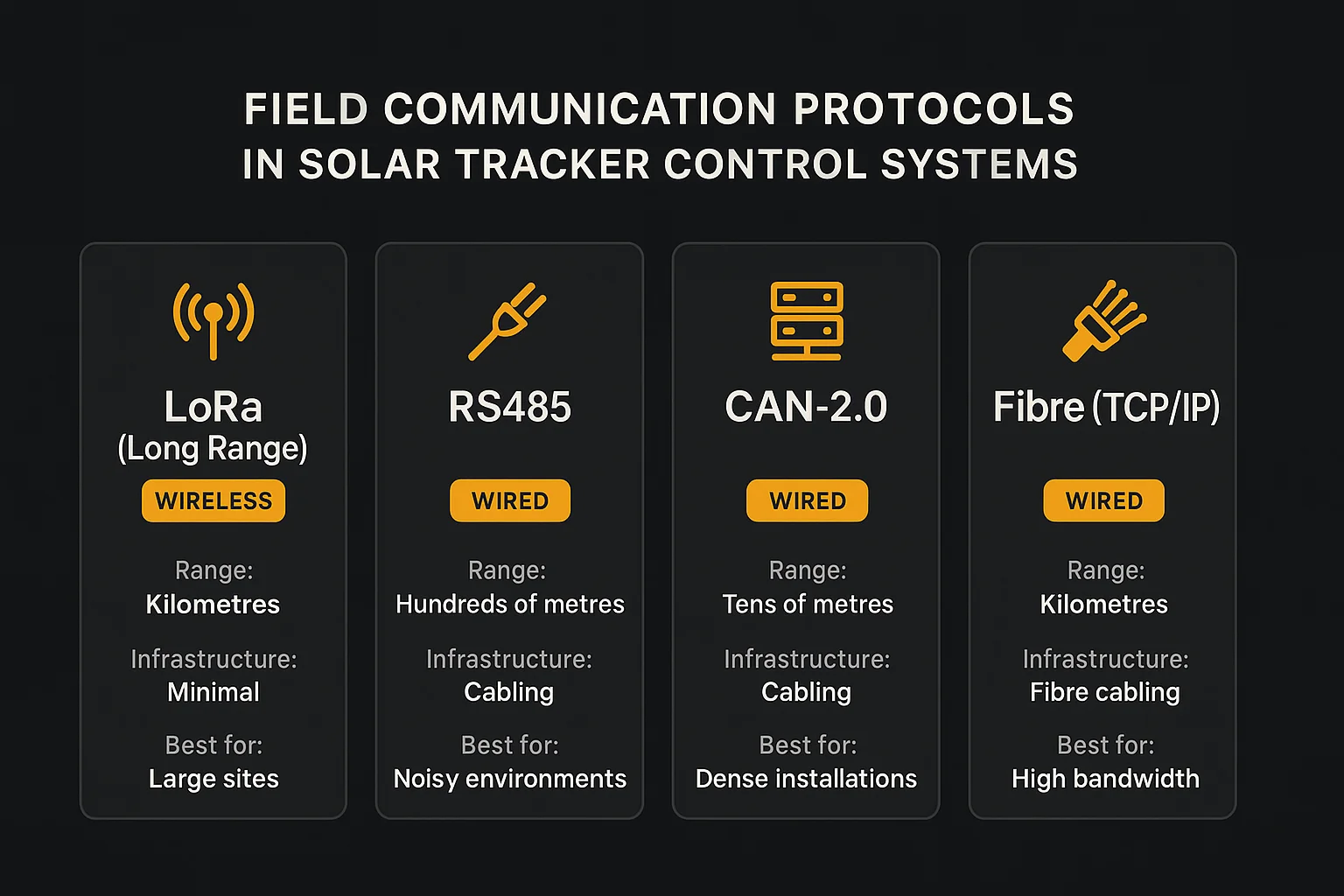
Field Communication Protocols
LoRa (Long Range)
Wireless
Low-power, long-range wireless communication ideal for large sites where wired infrastructure is impractical. Ranges up to several kilometres with minimal infrastructure.
Best for: Large sites, difficult terrain, rapid deployment
RS485
Wired
Industrial wired communication standard for reliable, noise-resistant data transfer. Supports daisy-chain topology with proven performance in harsh electrical environments.
Best for: Sites with existing wired infrastructure, electrically noisy environments
CAN-2.0
Wired
Controller Area Network protocol designed for reliable communication in industrial and automotive environments. Supports multi-master topology with built-in error handling.
Best for: Dense installations, high-reliability requirements
Fibre (TCP/IP)
Wired
TCP/IP communication over fibre optic cabling for high-bandwidth, low-latency field connections. Fibre provides immunity to electromagnetic interference and supports long cable runs without signal degradation.
Best for: High-bandwidth sites, long cable runs, EMI-sensitive environments
Protocol Selection
Protocol choice is made per site or per site section during deployment planning. Factors include site size, terrain, existing infrastructure, electrical noise environment, bandwidth requirements, and deployment timeline.
| Factor | LoRa | RS485 | CAN-2.0 | Fibre (TCP/IP) |
|---|---|---|---|---|
| Range | Kilometres | Hundreds of metres | Tens of metres | Kilometres |
| Infrastructure | Minimal (wireless) | Cabling required | Cabling required | Fibre cabling required |
| Noise immunity | Good | Excellent | Excellent | Immune (optical) |
| Bandwidth | Low | Moderate | Moderate | High |
| Deployment speed | Fast | Moderate | Moderate | Moderate |
Upstream Connectivity
The NCU connects to the TrackLab monitoring platform through an upstream path defined during deployment planning. Public documentation should describe that planning approach clearly without hard-coding transport claims that have not been specifically verified.
Deployment-Specific Uplink
The public architecture supports an upstream link from the NCU to the monitoring platform, but the exact uplink technology is defined per deployment and should only be published when verified for that project.
Site Network Integration
Where site infrastructure allows it, the upstream path can be aligned to existing network architecture and operational requirements.
Resilience Planning
Remote deployments often require explicit resilience planning for intermittent or constrained upstream connectivity. Public content should describe the planning model without overclaiming a universal transport stack.
Verified Public References
LoRa
Long-range wireless field communication option referenced in public documentation
RS485
Industrial wired field communication option referenced in public documentation
CAN-2.0
Controller network protocol referenced in public documentation
Fibre (TCP/IP)
High-bandwidth optical field communication option referenced in public documentation
Related Documentation
Share this resource
Cite this page
TrackLab Solar. (2026). Communications & Integrations. Retrieved from https://tracklabsolar.com/technology/communications-and-integrations
Need help choosing communication protocols?
Our engineering team can assess your site conditions and recommend the optimal communication architecture for your deployment.